







Not every Facebook account is made equal.
Some profiles appear authentic — real names, old posts, dozens of friends — yet collapse within hours of login.
Others remain stable for years, running ads, joining groups, or managing pages without ever hitting a checkpoint.
If you’re doing social marketing, MMO, or seeding campaigns, account trust is everything.
It determines whether you can post freely, manage multiple pages, or maintain long-term stability across regions.
This guide explains the technical layers that define a high-quality Facebook account and how to select the one that matches your operational goals.
1. Why Many Facebook Accounts Get Disabled or Restricted Quickly
Even before you post, Facebook’s AI is analyzing your login pattern, IP address, and activity behavior.
Most low-quality or cloned accounts fail because their internal data doesn’t look like a real human footprint.
1.1 Why Facebook Accounts Lose Trust Fast
Facebook assigns every profile a “trust graph.”
This score updates based on login consistency, friend network, device identity, and community behavior.
Accounts lose trust quickly when:
- They log in from suspicious or blacklisted IPs.
- They add too many friends in a short time.
- They post identical content to multiple groups.
- They reuse device fingerprints already linked to restricted profiles.
When your trust graph drops below a threshold, the account gets flagged for facebook checkpoint or even permanent restriction.
For MMO and seeding operations, one bad login pattern can trigger cascading account losses.
1.2 What Triggers Facebook Checkpoints or Account Restrictions
Checkpoints happen when Facebook detects mismatched login data or automated behavior.
The system compares your IP, device, and browser to historical records.
Common triggers include:
- Logging in from a new country within 24 hours.
- Using proxies with shared subnets across multiple accounts.
- Sudden ad activity or group posting without warm-up.
- Inconsistent language or timezone settings.
Each event raises a red flag. When several combine, Facebook freezes your access for verification — and that’s when you see “Your account has been temporarily restricted.”
This is why experienced marketers rely on aged facebook account sources like MegaAcc, accounts with natural history and stable trust scores.
Learn more about verified account types here:
👉 MegaAcc Facebook Accounts
2. What Defines a High-Quality Facebook Account
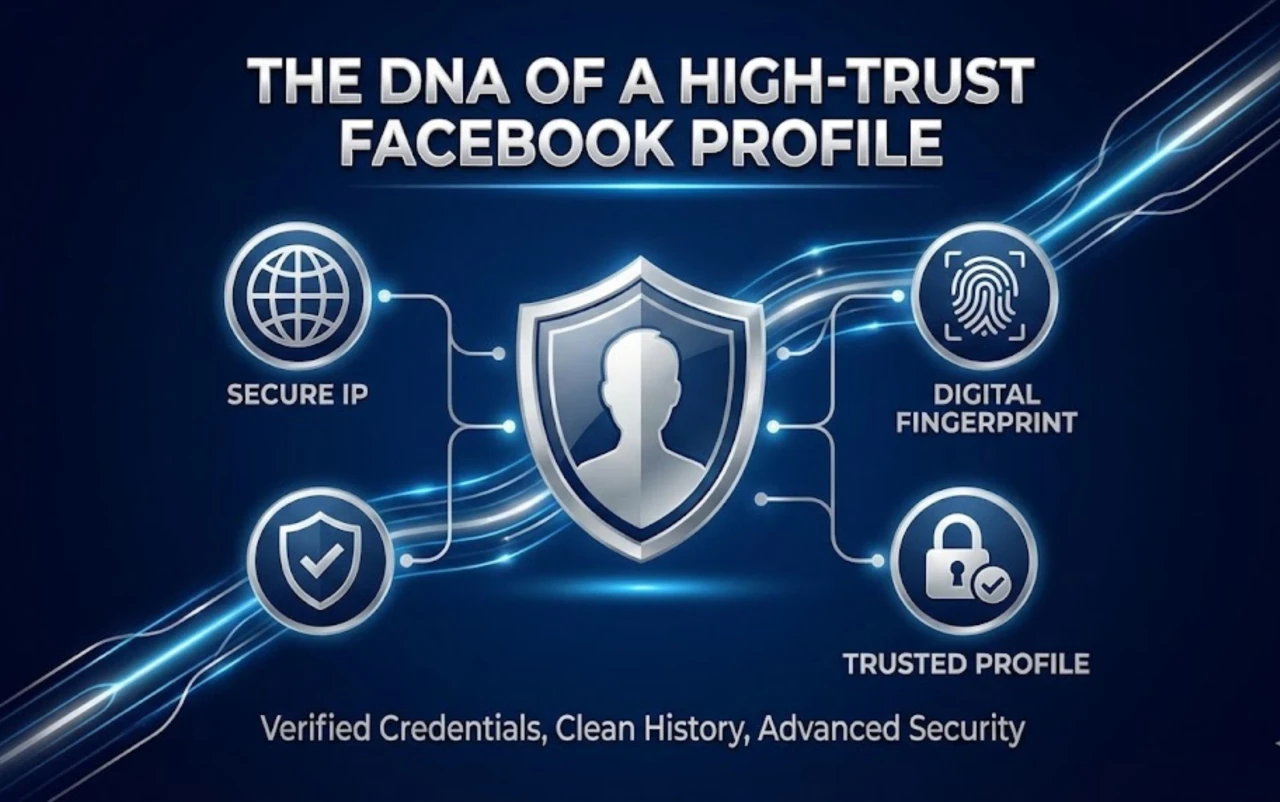
A high-quality Facebook account behaves like a real person.
It shows balanced, predictable activity and logical metadata that match human habits.
Five main factors define this standard: age, activity, IP consistency, regional logic, and verification.
2.1 Aged Profiles – The Foundation of Facebook Trust
Account age is the first trust metric Facebook evaluates.
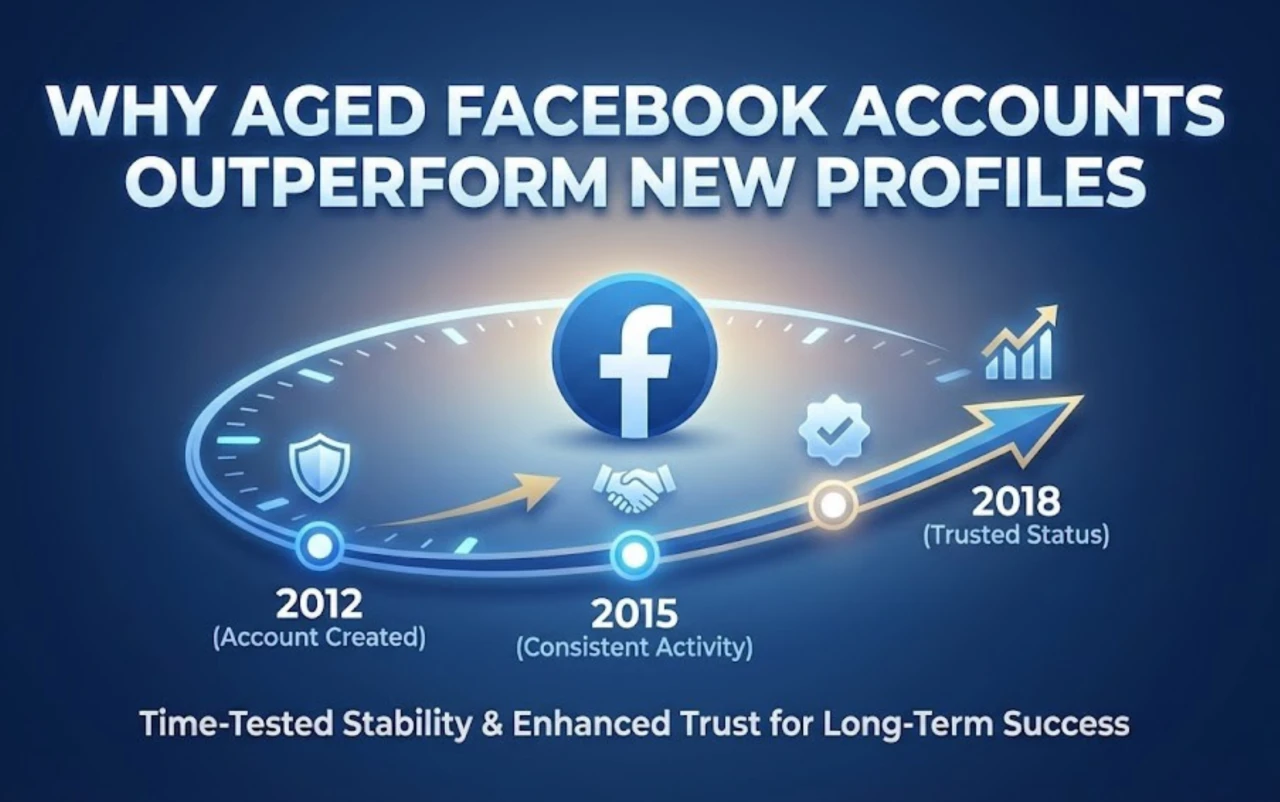
Older accounts (created 2012–2018) have proven behavioral stability, long-term session logs, and consistent login patterns.
Why this matters:
- Facebook’s AI marks aged IDs as low risk.
Older profiles face fewer checkpoints. - Ads and posts from aged accounts spread further before moderation.
An aged Facebook account isn’t just “old” — it’s seasoned.
It’s gone through policy updates, device changes, and network shifts while staying active.
That data maturity gives the profile algorithmic immunity against instant bans — a crucial edge for ad buyers and group admins.
2.2 Realistic Activity and Engagement Patterns
Facebook recognizes authentic human rhythm: scroll, post, comment, pause, repeat.
Aged accounts with organic activity history mimic that pattern perfectly.
They contain:
- Friends added over time, not all at once.
- Posts spread across months or years.
- Genuine comment threads instead of filler text.
Low-quality accounts, by contrast, post identical content or stay silent for years — both behaviors that trip Facebook’s authenticity filters.
Realistic engagement means:
- You can join groups safely.
- Comments stick without being hidden.
- Reactions count toward real reach.
That’s why MegaAcc aged profiles are tested for consistent timeline behavior before delivery, ensuring each account feels alive from day one.
2.3 Stable IP, Device, and Regional Consistency
Every Facebook login creates a trace: IP address, browser fingerprint, operating system, timezone.
When these variables shift too often, Facebook assumes suspicious activity.
High-quality accounts maintain stable IP/device records, preferably through Random IP environments.
This multi-region footprint trains Facebook’s AI to accept location variance as normal.
Key rules for IP and device safety:
- Always match IP region with the account’s original country.
- Avoid mass logins from the same proxy.
- Use anti-detect browsers like AdsPower or GoLogin to isolate environments.
These methods reduce the risk of facebook account restricted loops that plague cloned or farmed profiles.
2.4 Verified Information and Security Layers
Verification adds a second line of trust.
Facebook prioritizes accounts connected to verified emails (Gmail, Outlook) and with two-factor authentication enabled.
Verified profiles:
- Recover faster during checkpoint events.
- Retain Ads Manager access even after device changes.
- Sync better with Meta’s advertising tools.
MegaAcc accounts include verified credentials and recovery setups to ensure quick restoration in case of access issues.
Security also supports broader stability — a verified Facebook account integrates seamlessly with Messenger, Instagram, and Business Manager.
2.5 Regional and Profile Logic – The Subtle Detail Facebook Notices
One of Facebook’s hidden filters evaluates profile coherence: whether your name, gender, language, and login region make sense together.
For example, a “John Miller” logging in daily from Vietnam triggers mismatch warnings.
But a Western Name – US IP – English language profile looks naturally consistent.
That’s why MegaAcc categorizes accounts into:
- Facebook Random IP – Western Name → for global users needing natural diversity.
- Facebook US – Live Ads – 30+ Friends → for verified ad managers and marketers.
- Aged Facebook – Random IP – 1000–5000 Friends → for social seeding, group growth, and page credibility.
Each type maintains logical metadata alignment — essential for avoiding facebook checkpoint verification requests.
3. Why Account Age and Realistic Activity Are Key to Long-Term Stability
Many users think Facebook bans accounts because of content.
In reality, most accounts are disabled due to behavioral inconsistency.
Facebook doesn’t ban what you post — it bans how you act.
3.1 How Facebook Measures Account Lifetime Value
Facebook’s machine learning model measures something similar to “customer lifetime value,” but for identities.
It tracks how long an account stays active without violations, how often it logs in, and whether it interacts across Meta platforms.
Accounts that show steady multi-year activity are treated as trusted users.
That’s why aged profiles can manage ads, create pages, and join large groups — privileges new accounts can’t hold without cooldown periods.
3.2 Why Aged Facebook Accounts Survive Checkpoints Better
When a new account triggers checkpoint, it’s instantly frozen.
When an aged account triggers the same flag, it often gets a verification prompt — then resumes activity.
This difference comes from trust decay rate: aged profiles have slower decay because their data supports credibility.
So if you’re managing multiple business managers, groups, or ad campaigns, aged accounts offer insurance against total shutdowns.
4. Different Types of Facebook Accounts and Which One You Should Choos
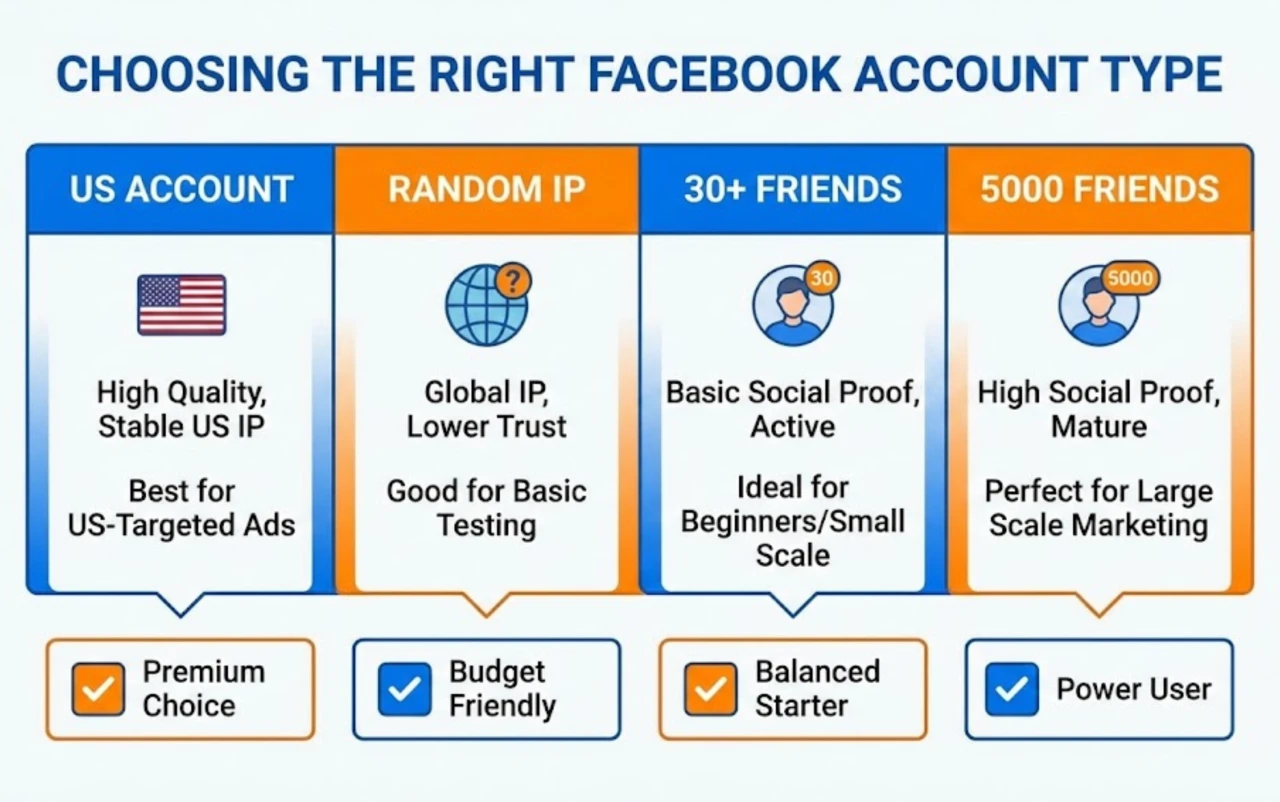
Not every Facebook account serves the same purpose.
Depending on your operation — ads, seeding, MMO, or social marketing — you’ll need accounts with different footprints, regions, and activity levels.
Below are the main categories used by professional marketers and automation teams.
4.1 Facebook Random IP – Western Name
Purpose: Multi-region operations and international seeding.
These accounts are designed with diverse IP footprints and Western-style identity data (English names, U.S. or EU regions).
They simulate authentic users from multiple countries, making them ideal for international campaigns and projects requiring location flexibility.
Technical advantages:
- Multi-region IP logs help normalize login variations.
- Western identity metadata aligns with U.S./EU ad targeting logic.
- Low verification frequency compared to region-locked accounts.
Recommended for:
- Global seeding across pages and groups.
- Affiliate or MMO teams operating from Asia but targeting Western audiences.
- Users who need facebook checkpoint tolerance in varied IP setups.
Why it works:
Facebook’s detection system treats these profiles as digital nomads — users who travel often but remain consistent.
That behavioral pattern fits perfectly with international operations where devices, languages, and timezones shift constantly.
4.2 Facebook US – Live Ads – 30+ Friends
Purpose: Meta Ads and verified Business Manager operations.
This is the premium segment of Facebook accounts — built specifically for ad buyers and marketing agencies.
Each account is aged, verified, and active within the U.S. region, featuring natural friend lists and organic activity logs.
Key features:
- Verified Gmail login and 2FA protection.
- Stable login from U.S. IPs and clean browser fingerprints.
- Active friend network (30–50+) that enhances realism.
- Can integrate smoothly with Meta Ads Manager and Business Suite.
Recommended for:
- Advertisers needing stable Meta Business Manager verification.
- Agencies running cross-client ad campaigns.
- Marketers requiring accounts with high daily spending potential.
Why it works:
Meta’s ad system prefers U.S.-based profiles with verifiable history.
Aged U.S. accounts carry higher ad reputation scores, meaning fewer review delays and higher ad approval rates.
For ad reliability, these profiles are unmatched.
You can learn more about their structure in MegaAcc Facebook Product Listings.
4.3 Aged Facebook – Random IP – 30+ Friends
Purpose: Local social marketing and group engagement.
These accounts are aged (2014–2018), pre-loaded with realistic activity and moderate friend lists.
They are ideal for individuals or small teams running community-based campaigns or influencer-style seeding.
Technical advantages:
- Balanced footprint: aged + diversified IP.
- Enough friend network to appear credible in groups.
- Posts and likes spread naturally over time.
- Fewer restrictions on joining and commenting in public groups.
Recommended for:
- Social seeding teams.
- Page moderators managing engagement pools.
- Mid-level MMO operations needing scalable stability.
Why it works:
These accounts combine the “trust of age” with the “flexibility of Random IP.”
They perform smoothly across multiple logins without hitting the facebook account restricted barrier.
4.4 Aged Facebook – Random IP – 1000–5000 Friends – Many Posts
Purpose: High-credibility seeding, group administration, and large-scale social operations.
These are top-tier aged accounts, built for operations requiring the highest social proof.
Their timelines are rich with content — personal posts, photos, friend interactions — and their networks often exceed 1,000 friends.
Technical advantages:
- Massive social credibility → higher organic reach in posts and comments.
- Complex history → extremely low chance of checkpoint verification.
- Clean Random IP footprint → compatible with multi-login systems.
Recommended for:
- Agencies managing community pages or niche groups.
- Seeding networks where reputation determines visibility.
- Cross-platform social operations (Messenger, Instagram integration).
Why it works:
Facebook’s algorithm measures interaction density.
Accounts with deeper friend networks and active timelines get priority in visibility and engagement weighting.
For large-scale seeding, these profiles offer the best return on trust.
5. How to Pick the Right Facebook Account for Your Purpose.
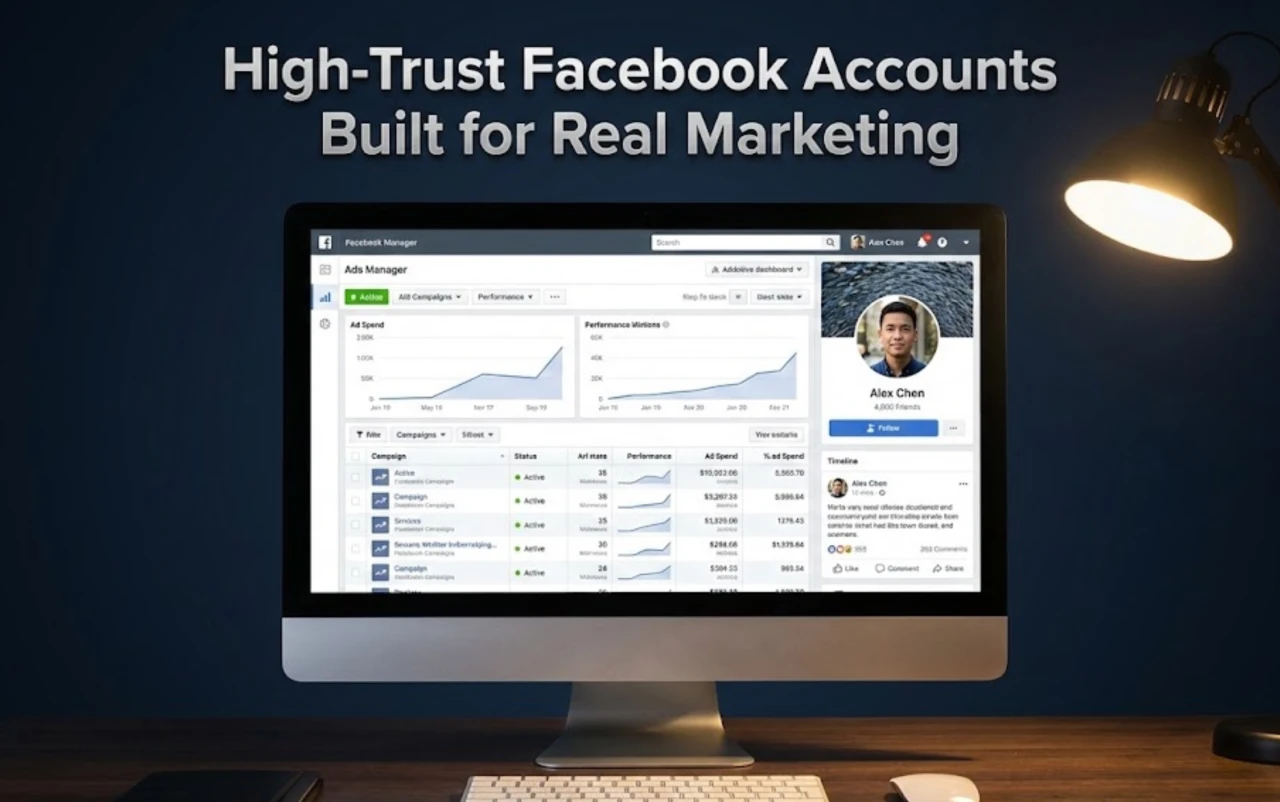
Every Facebook account type fits a specific goal.
Selecting correctly ensures both stability and performance — buying the wrong one wastes budget and risks mass bans.
5.1 Match Account Type to Use Case
Below is a simple guide for choosing:
- Aged Facebook (30–5000 Friends):
Use for social marketing, seeding, or managing groups/pages.
Reliable posting and consistent friend network. - Facebook US / Western Name:
Use when targeting international audiences or operating under a global brand identity.
Aligns with Western-language campaigns and cross-border ad setups. - Random IP Facebook:
Ideal for multi-location users who log in from different devices or networks.
The IP diversity prevents checkpoints triggered by region shifts. - High-Friend Accounts (1000–5000):
Best for social proof and group authority.
Facebook gives priority ranking to accounts with strong friend graphs.
Each option reflects a unique combination of trust, realism, and scalability.
Buying without understanding these dimensions often leads to instant bans or account decay.
5.2 Factors to Avoid When Buying Facebook Accounts
Even within the same category, quality varies widely.
Avoid these red flags when choosing an account provider:
- Recently created or recycled accounts.
“Fresh” profiles with fake history will trigger restrictions almost immediately. - Shared IP logins or reused cookies.
These often result in chain bans across accounts. - Inconsistent region metadata.
Names, IPs, and timezones that don’t align lower trust scores. - No verification layer.
Accounts without 2FA or recovery options are risky for any business use.
If your Facebook account fails after one login, it’s not your proxy — it’s poor source quality.
Always verify that your provider offers clean, pre-tested accounts with stable login history.
5.3 Why Buying from Verified Sources Like MegaACC Matters
The Facebook algorithm evolves constantly.
Low-quality accounts that worked a year ago no longer survive today’s AI-driven security filters.
MegaAcc’s Facebook accounts are verified, aged, and tested under real usage environments.
Each account includes:
- Verified Gmail and 2FA protection.
- Authentic activity timeline with organic engagement.
- Random IP footprint for natural location variation.
- Clean, unique browser fingerprint.
Unlike mass resellers, MegaACC doesn’t recycle accounts — every identity is created and aged under controlled IP systems, ensuring long-term trust.
That’s why experienced MMO teams and ad managers rely on MegaACC for sustainable scaling.
See full listings here:
👉 Facebook Accounts – Verified Categories
5.4 Long-Term Strategy: How to Maintain High-Quality Accounts
Buying a good account is only the first step; maintaining its health is equally important.
Best practices include:
- Warm up each account for 3–5 days before heavy use.
- Assign dedicated IP and browser environments.
- Avoid posting or commenting aggressively during the first week.
- Keep interactions natural — mix social, group, and content activity.
- Rotate usage patterns to mimic normal users.
Facebook rewards human consistency — small, steady actions always outperform mass automation.
By following these guidelines, even aged accounts stay strong for months or years.
5.5 Why Account Quality Impacts Ad and Page Performance
Facebook’s system interlinks all assets: personal profiles, pages, and ad accounts.
When your root profile is trusted, every connected page or Ads Manager inherits that stability.
That’s why marketers prioritize high-quality Facebook accounts —
they reduce risk, improve ad delivery speed, and protect business continuity.
It’s not just about owning a profile; it’s about building an ecosystem where every login, comment, and click signals authenticity.
Get Premium Facebook Accounts at MegaACC With Strong Trust and Realistic Activity
Choosing the right Facebook identity is the difference between scaling and shutdown.
MegaAcc provides premium verified accounts engineered for real-world reliability:
- Aged Facebook (30–5000 friends).
- Western Name / US Name options.
- Random IP footprints for stable logins.
- Many posts, high activity timelines.
- Ready for social marketing, seeding, and MMO use.
Start with verified trust.
Explore all Facebook account packages here:
👉 https://megaacc.com/product/product-list?category=facebook